3 Books That Will Completely Change Your Perspective on Work
By Steph Miller on April 20, 2026
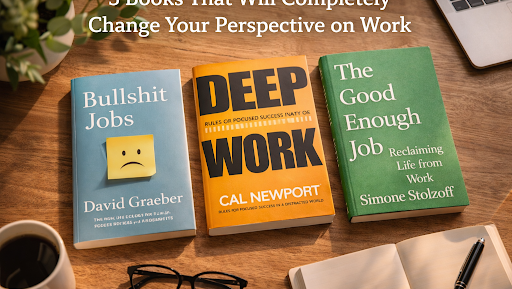
For many people, work is something to endure. A source of stress, obligation, or endless to-do lists that dominate daily life. But occasionally, a book comes along that shifts how we see work entirely, not by offering productivity hacks, but by questioning the assumptions we rarely stop to examine.
The books below do not promise instant success or perfect balance. Instead, they challenge how we think about ambition, purpose, and the role work plays in shaping identity. Reading them often leads to uncomfortable realizations, but also to clarity.
If you feel stuck, overworked, or unsure why work feels heavier than it should, these three books can quietly change how you approach it.
Bullshit Jobs by David Graeber
David Graeber’s Bullshit Jobs asks a question many people are afraid to voice out loud: what if a large portion of modern work is meaningless?
Based on interviews and real-life stories, Graeber explores jobs that even the people doing them believe should not exist. These roles often pay well, look impressive on paper, and yet leave workers feeling empty, bored, or morally conflicted.
The book reframes exhaustion and dissatisfaction not as personal failure, but as a systemic issue. It explains why being busy does not always equal being useful and why meaningless work can be psychologically damaging.
After reading this book, many people begin to question not just their job, but how society measures value, success, and productivity.
Deep Work by Cal Newport
Deep Work does not argue that work itself is the problem. Instead, it challenges how modern workplaces destroy focus.
Cal Newport makes the case that the ability to concentrate deeply on demanding tasks is becoming increasingly rare, and increasingly valuable. Constant emails, meetings, notifications, and performative busyness fragment attention and reduce the quality of output.
This book changes how readers view productivity. It shifts the focus from doing more to doing better. Work becomes less about visibility and responsiveness, and more about meaningful contribution.
For many readers, Deep Work sparks a reevaluation of boundaries, attention, and what truly deserves time and energy.
The Good Enough Job by Simone Stolzoff
Simone Stolzoff’s The Good Enough Job tackles one of the most deeply ingrained ideas in modern culture: that work should define who you are.
The book challenges hustle culture and the pressure to find identity, passion, and self-worth through career achievement. Stolzoff argues that expecting work to fulfill all emotional and personal needs is unrealistic and often harmful.
Rather than promoting disengagement, the book encourages a healthier relationship with work. One where jobs support life instead of consuming it.
This perspective can be freeing, especially for people who feel guilty for not loving their job or constantly striving for more.
Why these books resonate now
These books are not about quitting work or rejecting ambition. They are about perspective. Each one questions a different assumption: that all jobs are meaningful, that constant busyness equals value, and that work must be the center of identity.
Together, they reflect a broader cultural shift. People are increasingly aware that burnout is not a badge of honor and that fulfillment cannot come from work alone.
Reading these books often leads to quieter changes. Better boundaries. More intentional focus. Less guilt around rest and identity outside of work.
Changing how you work by changing how you think
Not every book changes behavior immediately. Some change language, others change awareness. These three do something more subtle but powerful: they change how work is framed in your mind.
Once that frame shifts, decisions follow naturally. What you prioritize, what you tolerate, and how you define success begin to look different.
Sometimes, the most meaningful career move is not a new job, but a new perspective.