Mandela Effect Examples That Will Make You Question Your Memory
By Kiwireport Staff on March 26, 2026
What exactly is the Mandela effect
The Mandela Effect occurs when a group of people remembers something differently from how it actually happened. These are not simple mistakes or minor inaccuracies. They are often vivid, specific memories that feel completely real.
Psychologists suggest that this phenomenon is linked to how our brains store and reconstruct memories. Rather than functioning like a video recording, memory is more like a story that gets rewritten over time. Influences such as suggestion, repetition, and cultural exposure can all shape what we think we remember.
The internet has amplified the Mandela Effect, allowing people from around the world to compare memories and realize they share the same incorrect recollections. This collective experience is what makes it so intriguing and, at times, unsettling.
Famous brand and logo mix-ups
One of the most common areas where the Mandela Effect appears is in brand names and logos. These are things we see frequently, yet our memories of them can still be surprisingly inaccurate.
A classic example is the “Berenstain Bears” children’s book series. Many people vividly remember it being spelled “Berenstein Bears,” with an “e” instead of an “a.” Despite checking old books and official records, the spelling has always been “Berenstain.”
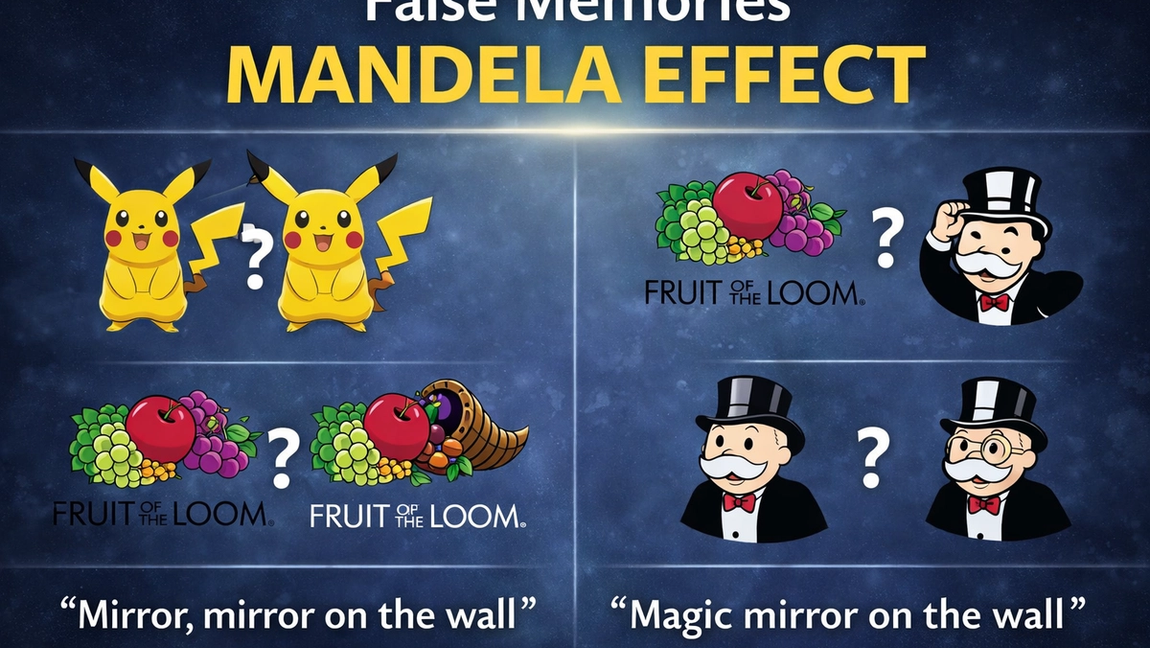
Another widely shared false memory involves the Monopoly mascot. Many people recall him wearing a monocle, but in reality, he never has. This confusion may stem from mixing him up with other characters associated with wealth and old-fashioned imagery.
Even well-known brands like KitKat are not immune. Some people remember a hyphen in the name as “Kit-Kat,” but the official branding has never included one. These small differences highlight how easily our minds can fill in details that feel logical but are incorrect.
Movie lines you remember wrong
Films are another rich source of Mandela Effect examples, especially when it comes to iconic quotes. Many of these lines have been repeated so often that their incorrect versions have become more popular than the originals.
One of the most famous examples is from Star Wars. People often quote Darth Vader as saying, “Luke, I am your father.” In reality, the line is, “No, I am your father.” The incorrect version likely emerged because it provides more context when quoted outside the scene.
Similarly, in the movie Casablanca, many people remember the line “Play it again, Sam.” However, the actual line is slightly different: “Play it, Sam. Play ‘As Time Goes By.’”
Another example comes from Snow White, where people often recall the Evil Queen saying, “Mirror, mirror on the wall.” The original line is actually “Magic mirror on the wall.” Despite this, the incorrect version has become deeply ingrained in popular culture.
Everyday objects that aren’t what you think
The Mandela Effect also extends to everyday items, making it even more surprising. These are things you’ve likely seen hundreds of times, yet your memory may still get them wrong.
Take the Fruit of the Loom logo, for instance. Many people remember it featuring a cornucopia behind the fruit. However, no such element has ever existed in the official logo. This shared memory has puzzled many who are convinced they have seen it.
Another example is Pikachu from Pokémon. Some people recall him having a black tip on his tail, but in reality, his tail is completely yellow. This small detail often catches fans off guard when they revisit the character.
Even geography is not immune. Some individuals believe that New Zealand is located northeast of Australia, when it is actually southeast. These kinds of spatial misconceptions show how our mental maps can be flawed.
Why our brains create false memories
At its core, the Mandela Effect reveals something fundamental about human cognition: memory is not perfect. Our brains are designed to make sense of the world efficiently, not necessarily accurately.
One reason for false memories is pattern recognition. When something feels familiar, our brain fills in missing details based on what seems logical. For example, adding a monocle to the Monopoly man fits the stereotype of a wealthy, old-fashioned character.
Another factor is social reinforcement. When multiple people share the same incorrect memory, it becomes more convincing. Hearing others recall the same detail can strengthen your belief that it must be true.
Over time, repetition also plays a role. The more often an incorrect version is seen or heard, the more it replaces the original memory. This is why misquoted movie lines and altered brand names can feel so real.
A reminder not to trust everything you remember
The Mandela Effect is both fascinating and humbling. It reminds us that even our most confident memories can be flawed. While it may feel unsettling to realize that your mind can “rewrite” reality, it also highlights the complexity and adaptability of human cognition.
Rather than seeing it as a flaw, it can be viewed as a feature of how our brains process information. Memory is dynamic, shaped by experience, perception, and interaction with others.
So the next time you feel absolutely certain about a detail, it might be worth double-checking. You may just discover that your memory has been playing tricks on you all along.