
The 4-Day Work Week: Can It Actually Work? Pros and Cons
By Steph Miller on April 22, 2026
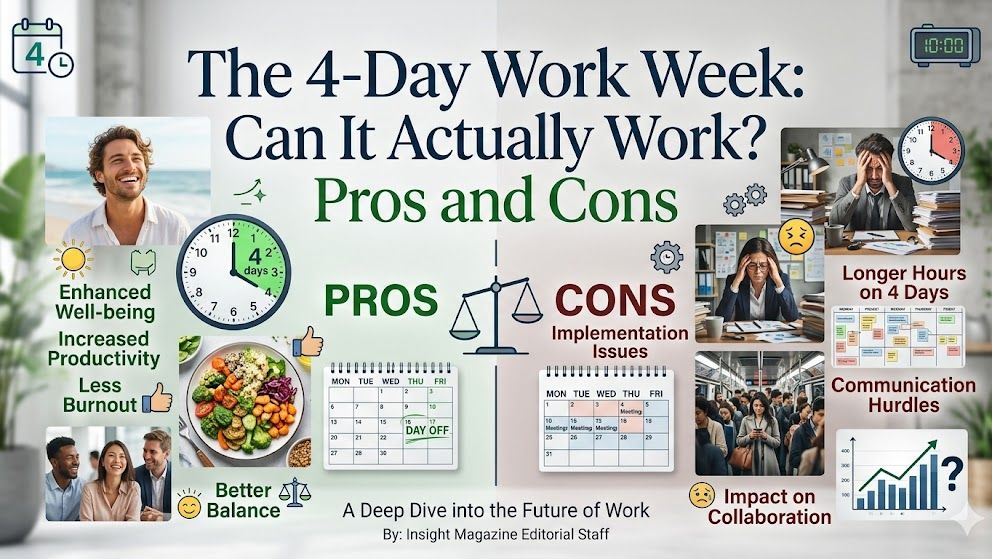
The idea of a four-day work week has shifted from a fringe experiment to a serious business conversation. Companies across industries are testing shorter workweeks without reducing pay, while employees increasingly question whether the traditional five-day schedule is outdated.
Supporters argue that productivity remains stable or even improves. Critics warn of operational challenges and hidden costs. Between enthusiasm and skepticism lies a simple question: can the four-day work week actually work in the real world?
The answer depends less on ideology and more on structure, expectations, and industry context.
Why the idea gained momentum
The push for a shorter work week gained traction during a period of global workplace disruption. Remote work proved that productivity was not strictly tied to office presence. Employees re-evaluated work-life balance, burnout became a widespread concern, and businesses faced pressure to improve retention.
Pilot programs in various countries showed promising results. In many cases, companies reported maintained or increased productivity alongside improved employee satisfaction. Absenteeism dropped. Recruitment improved. Workers reported lower stress levels.
These outcomes fueled the argument that reducing hours does not necessarily reduce output.
The potential benefits for businesses
One of the strongest arguments for a four-day work week is productivity efficiency. When hours are limited, teams often prioritize more effectively. Meetings become shorter. Distractions decrease. Work is structured with greater focus.
Employee morale is another major benefit. A consistent three-day weekend can significantly improve work-life balance, leading to lower burnout and higher engagement.
Retention and recruitment advantages are also notable. Offering a four-day week can differentiate a company in competitive job markets, especially when attracting skilled talent.
Some organizations report cost savings as well, particularly in office-related expenses such as utilities and operational overhead.
The benefits for employees
For employees, the appeal is obvious. More time for family, personal projects, rest, or education can dramatically improve quality of life.
Mental health improvements are frequently cited. Extended weekends allow for deeper recovery, reducing chronic stress and emotional exhaustion.
Work satisfaction may increase when employees feel their time is respected. The psychological impact of having more control over one’s schedule can lead to stronger loyalty and motivation.
Importantly, successful models maintain full pay, preventing financial stress from undermining the benefits of reduced hours.
The operational challenges
Despite promising trials, the four-day work week is not universally simple to implement.
Certain industries require continuous coverage. Healthcare, hospitality, manufacturing, and customer service sectors may struggle to compress hours without hiring additional staff or restructuring shifts.
There is also the risk of work compression. If expectations remain unchanged, employees may feel pressured to complete five days of work in four, intensifying stress rather than reducing it.
Coordination can become complicated when teams adopt staggered schedules. Collaboration across departments may require careful planning to avoid bottlenecks.
Without a thoughtful redesign, the shorter week can create logistical friction.
Productivity versus output
One central debate revolves around the definition of productivity. Knowledge-based roles often measure output by results rather than hours. In these environments, efficiency gains are more achievable.
However, roles tied directly to time-based services face constraints. A restaurant cannot serve the same number of customers in fewer operating hours without operational adjustments.
For the four-day model to work sustainably, companies must distinguish between time spent working and value created.
This often requires rethinking workflows, automating repetitive tasks, and eliminating unnecessary meetings.
Cultural and managerial shifts
Adopting a four-day work week is not merely a scheduling change. It represents a cultural shift.
Managers must move away from monitoring hours toward measuring outcomes. Clear communication, defined goals, and trust become essential.
Leadership buy-in is critical. Without support from top management, shortened weeks can be undermined by unrealistic expectations or inconsistent implementation.
Organizations that succeed tend to treat the transition as a structural redesign rather than a temporary perk.
Is it sustainable long-term
The long-term viability of a four-day work week depends on adaptability. What works for one company may not translate directly to another.
Hybrid models may emerge, offering flexible compressed schedules rather than universal reductions. Some companies may adopt seasonal four-day weeks or trial periods to test impact.
Economic conditions also play a role. In times of labor shortages, the model may offer competitive advantages. During downturns, businesses may prioritize cost efficiency differently.
The model is not a universal solution, but it is a serious contender for reshaping traditional work patterns.
A changing definition of work
The discussion around a four-day work week reflects a broader shift in how society defines productivity and success. The traditional five-day schedule was designed for an industrial era, not a digital one.
As technology evolves and workplace expectations change, rigid structures are being questioned.
Whether the four-day work week becomes standard practice remains uncertain. But the conversation itself signals a growing recognition that time, efficiency, and wellbeing are interconnected.
In the end, the real question may not be whether it can work, but whether businesses are willing to redesign work in ways that allow it to.