The End of Passwords: How Passkeys Work and Why They’re Safer
By Steph Miller on April 20, 2026
Passwords have been a necessary frustration for decades. We create them, forget them, reuse them, reset them, and worry about them being stolen. Despite constant advice to use long, unique passwords, most people still struggle to manage them safely.
That is why passkeys are gaining attention as a serious alternative. Backed by major tech companies and built into modern devices, passkeys promise a future without memorized passwords at all. Instead of something you know, access relies on something you have and something you are.
Understanding how passkeys work helps explain why many experts believe passwords are slowly coming to an end.
Why passwords are no longer enough
Passwords fail not because people are careless, but because the system itself is flawed. Humans are not good at remembering dozens of complex, unique strings. As a result, many reuse passwords across sites or choose ones that are easy to guess.
This creates opportunities for attackers. Data breaches expose password databases, phishing tricks users into handing over credentials, and automated tools can guess weak passwords at scale. Even two-factor authentication, while helpful, still relies on passwords as the first line of defense.
The problem is not just security. Passwords also create friction. Logging in becomes a repeated interruption, especially across multiple devices. Resetting flows wastes time and frustrates users, while still leaving room for abuse.
Passkeys were designed to solve both the security and usability problems at once.
What passkeys actually are
A passkey is a modern authentication method based on cryptography rather than shared secrets. Instead of creating a password that a service stores, your device generates a unique pair of cryptographic keys.
One key stays on your device and is never shared. The other is stored by the service you are logging into. When you try to sign in, your device proves it holds the private key without revealing it.
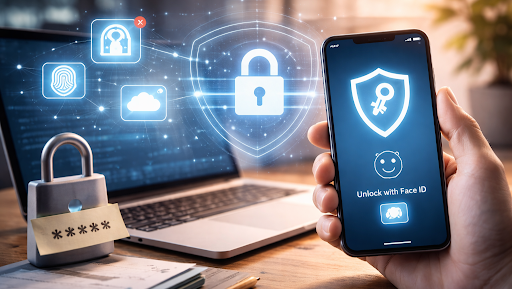
To confirm it is really you, the device uses a biometric check such as Face ID, fingerprint scanning, or a device PIN. No password is typed, sent, or stored.
Because passkeys are tied to specific devices and websites, they cannot be reused elsewhere. Even if a service is breached, the stored public keys are useless on their own.
How passkeys protect against common attacks
One of the biggest advantages of passkeys is resistance to phishing. Fake websites may look convincing, but they cannot trick your device into using a passkey on the wrong domain. If the site is not legitimate, the authentication simply fails.
Passkeys also eliminate password reuse. Each service gets a unique key pair, removing the chain reaction effect where one breach leads to many compromised accounts.
There is no password database for attackers to steal, no credentials to guess, and nothing for users to accidentally share. Authentication happens silently in the background, with the biometric check acting as confirmation.
This makes passkeys not just safer in theory, but safer in everyday use.
Where passkeys are already being used
Passkeys are not experimental. Major platforms like Apple, Google, and Microsoft already support them, and many popular apps and websites are beginning to offer passkey sign-in options.
Most modern smartphones, tablets, and laptops can store passkeys securely and sync them across devices through encrypted cloud services. This means users can sign in on a new device without starting from scratch.
For now, many services allow passkeys alongside passwords rather than replacing them completely. This transition period helps users adopt the technology gradually while maintaining compatibility with older systems.
Over time, passwords may become a backup rather than the default.
What switching to passkeys means for users
For users, passkeys simplify daily digital life. Signing in becomes faster and less stressful. There is nothing to remember, nothing to reset, and fewer security warnings to worry about.
The main adjustment is trusting devices more. Since access depends on having your phone or computer, losing a device becomes more important. However, recovery methods and device-level security protections help mitigate this risk.
Passkeys also encourage better security habits without requiring technical knowledge. Users get stronger protection automatically, without having to understand encryption or manage password vaults.
Why the move away from passwords matters
The shift to passkeys reflects a broader change in how security is designed. Instead of expecting people to behave perfectly, systems are adapting to how people actually live and work.
Passwords have reached their limits. They ask too much from users while offering too little protection in return. Passkeys offer a path forward that is both safer and easier.
As adoption grows, logging in may finally become something you no longer have to think about. The end of passwords will not happen overnight, but it has clearly begun.