The Future of Cinema: Will AI-Generated Actors Ever Win an Oscar?
By Steph Miller on April 21, 2026
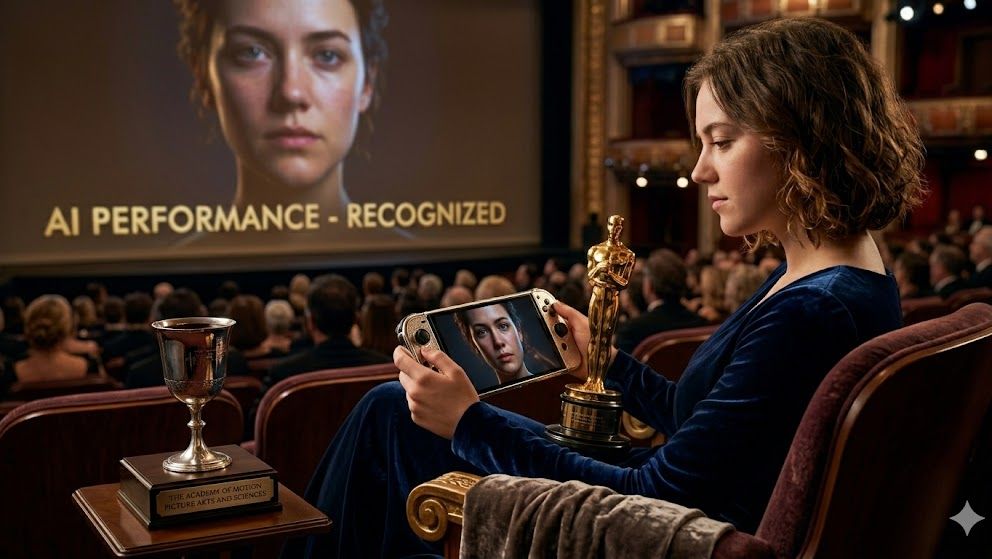
Cinema has always evolved alongside technology. From silent films to talkies, from black and white to CGI blockbusters, each leap forward has reshaped how stories are told. Now, a new question is emerging: what happens when the actors themselves are no longer human?
Artificial intelligence is already capable of generating realistic faces, voices, and performances. Digital de-aging, deepfake technology, and fully synthetic characters are becoming more common in film production. As the technology improves, it raises a provocative possibility. Could an AI-generated actor one day win an Oscar?
The idea sounds futuristic, even controversial. But it may not be as far away as it seems.
What counts as an AI-generated actor
The concept of an AI actor exists on a spectrum. On one end are digital recreations of real performers, enhanced by AI to smooth expressions, alter age, or replicate voice. On the other end are fully synthetic characters generated entirely by machine learning models, with no human performer behind them.
Some films already blur these lines. Actors have been digitally resurrected, de-aged, or enhanced with AI-driven facial mapping. Virtual influencers and digital avatars are gaining popularity outside cinema, proving that audiences can connect emotionally with non-human personalities.
The key difference is authorship. Traditional performances are shaped by human emotion, interpretation, and physical presence. AI-generated performances are constructed from data patterns, trained on existing material, and refined through algorithms.
At what point does that construction become performance in its own right?
The artistic question
Awards like the Oscars celebrate not just technical achievement, but artistic expression. Acting is traditionally seen as deeply human, rooted in lived experience, emotional nuance, and improvisation.
An AI-generated actor would not feel fear, heartbreak, or joy. It would simulate them. But cinema itself is simulation. Sets are artificial. Lighting is manipulated. Dialogue is scripted.
If an AI performance moved audiences to tears, would its origin matter?
Some argue that art requires intention and consciousness. Without a human behind the role, the performance becomes a technical achievement rather than an artistic one. Others suggest that the emotional response of the audience is what truly defines art.
The debate is less about capability and more about meaning.
The industry implications
If AI-generated actors become viable contenders for major awards, the implications for the film industry would be enormous.
Studios could theoretically create entirely customizable stars. Actors who never age, never demand contracts, and never create scheduling conflicts. Entire films could be built around digital performers designed to fit precise creative visions.
But this possibility raises ethical concerns. What happens to working actors? How do unions respond? Who owns the likeness and voice of a digital performer trained on human data?
There are also legal questions. Current award rules assume a human nominee. An Oscar is awarded to a person. Would the trophy go to a development team, a studio, or an algorithm?
The audience factor
Ultimately, cinema depends on audience acceptance. Viewers form attachments to actors not just because of their performances, but because of their humanity. Interviews, red carpets, personal stories, and cultural presence all contribute to how audiences perceive film stars.
An AI-generated actor would lack that human backstory. While digital characters can be compelling, they may struggle to replace the authenticity audiences associate with real performers.
However, younger generations raised alongside virtual influencers and digital creators may view this differently. Emotional attachment to non-human personalities is already common in gaming, animation, and online culture.
The line between real and virtual identity is becoming less rigid.
Could it actually happen
Technically, it is possible. AI systems are already capable of generating hyper-realistic faces, replicating speech patterns, and even adjusting performances in real time. As computing power increases and datasets expand, the realism gap will continue to narrow.
Whether the Academy would recognize such a performance is another matter. Award institutions tend to move cautiously, especially when tradition is involved.
It is more likely that AI will first win in categories like visual effects, editing, or screenplay assistance before crossing into acting awards. A hybrid performance, where a human actor collaborates with AI enhancement, may serve as the bridge.
Redefining what performance means
The question of AI-generated actors winning Oscars forces a broader conversation about creativity. If storytelling tools evolve, so too must definitions of authorship and performance.
Cinema has always been a collaborative art form. Directors, writers, cinematographers, editors, and actors combine to create something larger than any individual contribution. AI may simply become another collaborator.
Whether that collaborator ever stands metaphorically on stage to accept a golden statue remains uncertain.
A future still unfolding
The future of cinema will likely include AI-generated actors in some form. Whether they remain supporting elements or take center stage depends on both technological progress and cultural acceptance.
An Oscar for an AI actor would symbolize more than a technical breakthrough. It would signal a shift in how society understands art, performance, and creativity itself.
For now, the idea remains speculative. But in an industry built on imagination, the possibility cannot be dismissed.