Why Movie Trailers Are Better (and Worse) Than the Actual Films
By Steph Miller on April 21, 2026
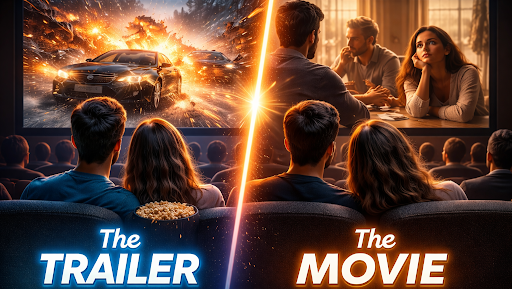
There is a specific kind of magic in watching a great movie trailer. Two minutes of perfectly timed music, dramatic pauses, clever dialogue cuts, and emotionally charged scenes can make almost any film feel unforgettable. Sometimes, the trailer feels so powerful that it lingers longer in your mind than the movie itself.
Yet there is also a familiar disappointment. You watch the full film expecting the same energy and impact, only to realize the trailer gave away the best moments or promised something the movie never truly delivers.
Movie trailers occupy a strange space. They are both miniature masterpieces and carefully edited illusions. In some cases, they are better than the films they promote. In others, they are the reason audiences leave theaters frustrated.
Why trailers often feel better than the movie
Trailers are designed for maximum impact. Editors take the strongest scenes, the sharpest lines, and the most visually impressive shots and compress them into a tightly constructed narrative. There is no filler, no slow pacing, and no unnecessary exposition.
Music plays a major role. A well-chosen song or dramatic score can elevate even average footage into something emotionally powerful. Trailers frequently use escalating sound design that builds tension in a way the full film cannot sustain for two hours.
Because trailers are short, they create intensity without fatigue. The audience experiences excitement in concentrated form. That compression can make the trailer feel more thrilling than the complete story.
The art of trailer editing
Trailer editing is its own craft. Editors often restructure scenes, alter timelines, and sometimes include footage that does not appear in the final cut. Dialogue can be rearranged to suggest a different tone or emphasis.
In some cases, trailers shift genre expectations entirely. A drama can be marketed as a thriller. A serious film can be edited to feel comedic. Through pacing and music alone, the emotional atmosphere can change.
This creative freedom allows trailers to tell a compelling story within minutes, but it also increases the risk of misalignment with the actual film.
When trailers oversell the experience
Disappointment often happens when the trailer promises something the movie cannot sustain. A few standout scenes may create the illusion of constant action, deep emotion, or sharp humor, even if those moments are rare in the full film.
Trailers also tend to highlight plot twists, visually stunning sequences, and dramatic confrontations. By the time audiences watch the movie, the sense of surprise may be reduced.
In extreme cases, viewers feel misled. The tone, pacing, or genre suggested in the trailer may not match the final product at all. Expectations rise based on those two minutes, and the film struggles to compete with the imagined version built in the viewer’s mind.
Why trailers can also make films better
Despite their flaws, trailers serve an important purpose. They create anticipation. The waiting period between seeing a trailer and watching the film builds excitement and emotional investment.
Sometimes, a strong trailer enhances the movie experience rather than diminishing it. Recognizing scenes from the preview can create a sense of familiarity and payoff. Iconic trailer moments often become iconic film moments.
Trailers also help audiences decide what is worth their time. In a world saturated with content, they function as curated previews, filtering choices and guiding attention.
The psychology behind the hype
Part of the reason trailers can feel superior lies in imagination. A trailer provides fragments, and the viewer fills in the gaps. The mind constructs a version of the film that perfectly matches personal taste.
When the full movie arrives, it replaces imagination with concrete detail. The mystery disappears, and the narrative becomes fixed. No matter how well executed, it cannot compete with the idealized version previously imagined.
This gap between expectation and reality is often what creates the sense that the trailer was better.
When trailers become cultural events
Some trailers achieve cultural status on their own. They are dissected online, replayed millions of times, and analyzed frame by frame. In these cases, the trailer is not just marketing but entertainment in its own right.
Teaser trailers, in particular, rely heavily on mood rather than plot. They create atmosphere without revealing too much, sometimes leaving audiences more intrigued than the finished film ultimately does.
The conversation around the trailer can sometimes overshadow the film’s release, shaping public perception before anyone has seen the full story.
The balance between promise and reality
At their best, trailers capture the essence of a film without distorting it. They build anticipation while leaving room for surprise. At their worst, they create inflated expectations that no movie could realistically satisfy.
Trailers are not meant to replace films. They are invitations. But because they are crafted so carefully and edited so tightly, they can sometimes feel like a superior, distilled version of the story.
In the end, the relationship between trailer and film is a delicate balance between promise and delivery. And sometimes, those two minutes of cinematic magic are unforgettable precisely because they leave us wanting more.